Saturday, May 26, 2012

Changes

What will we choose?


The carpenter's son we call Jesus of Nazareth was instrumental in helping to usher in the Age of Pisces. This was an age of deep universal truth, and also one of deep delusions, both of which are part of the Piscean energetic vibration, depending on how each individual and the society of individuals, responds to that vibration.

The old power paradigm of the Roman empire builders won the day by playing on the hopes and wishes of the peoples within their domain, thereby promoting the delusional side of Pisces and winning the battle between what we call "good" and "evil". This battle was symptomatic of the fear of losing power that is nearly always the catalyst for greater struggle at the changes of the ages.

The same is happening now, as the power elite attempt to hold on to their crumbling control structures, the physical and social as well as the economic, mental and what we might call the "spiritual", as we are now in the beginning of the much-touted Age of Aquarius, which represents purposeful change or, conversely, undirected or misdirected rebellion.

As a people and as individuals, it is entirely up to us how we resppond to those Aquarian energies. And our response is, above all other things, a statement and an indication of our growth and evolution as a species. We can either give in to the rebellious impulses, or we can choose to evolve, both individually and as a society.


Namaste',
Don

Saturday, May 19, 2012

Freedom!


All that should be
    Already is, or will be
    When we awaken
    And become free.

And our inner eyes
    Begin to see...

Me!  As I am,
    And as I could be
    When I make the choice
    To simply BE...
    The real ME!


Copyright © Donald Charles Rice

Monday, March 5, 2012

On Faith, God, and Truth


"If I didn't have spiritual faith, I would be a pessimist. But I'm an optimist. I've read the last page in the Bible. It's all going to turn out all right." -- Billy Graham


At the risk of inciting the self-righteous wrath of the "true believers", let me point out that the very book that Mr. Graham referred to, the Book of Revelations (or Apocalpse for Catholics) in that Bible states that 144,000 souls will be saved when "Jesus" returns.  Now, if that should happen tomorrow, it means that almost 7 BILLION souls will be consigned to Hell, or the lake of fire, there to suffer and burn for all eternity.
Yet Mr. Graham said, "It's all going to turn out all right."
Does anyone besides me see anything wrong with this?
Yet if the Bible-thumpers are right, I guess I'm going to wind up in that lake of fire myself, because I dare to use the brain God gave me to question the propaganda that keeps people living in fear.  But that's okay, because I'll have plenty of company.  Didn't the Bible also say:

  "Many will say to me in that day, Lord, Lord, have we not prophesied in thy name? and in thy name have cast out devils? and in thy name done many wonderful works?
And then will I profess unto them, I never knew you: depart from me, ye that work iniquity." (Matthew 7:22, 23)

So all those who claim Jesus as saviour, redeemer, et cetera, yet ignore or discount his teachings (remember the Beatitudes, among others?) will find themselves in that same lake of fire.
But if God is truly a loving Being (1 John 4:8: "God is love"), then there is no way he could cast all those souls away like that.  Why?  Because love, in it's truest sense, is totally unconditional.  It is therefore incapable of acting out of revenge, jealousy, anger, spite, disgust, or whatever.  Those are conditions that come about in the absence of love.
According to the Bible, Jesus said the two greatest "commandments" are to love God with all your heart, and to "... love one another as I have loved you."  So then, given the nature of love being unconditional, where do those who call themselves his followers get the idea that they can ignore the poor, the sick, the downtrodden, and anyone else they discriminate against, as if Jesus' teachings have no value? 
I am not a "Christian" in the accepted sense of that word.  I am only on the beginning of the road to learning what that even means and how to BE Christlike.  But I do know that I won't find it in the churches or temples or mosques.  In the Gospel of Thomas (one of the texts discovered at Nag Hammadi, Egypt, in 1945 and scientifically dated to have been written between 130 and 250 A.D.), Jesus is recorded as having said:
  "You will not find me in mansions of wood and stone, but in everything around you, AND WITHIN you.  Split a piece of wood, and you will find me; pick up a stone, and I am there."

Namaste',
Don

Thursday, March 1, 2012

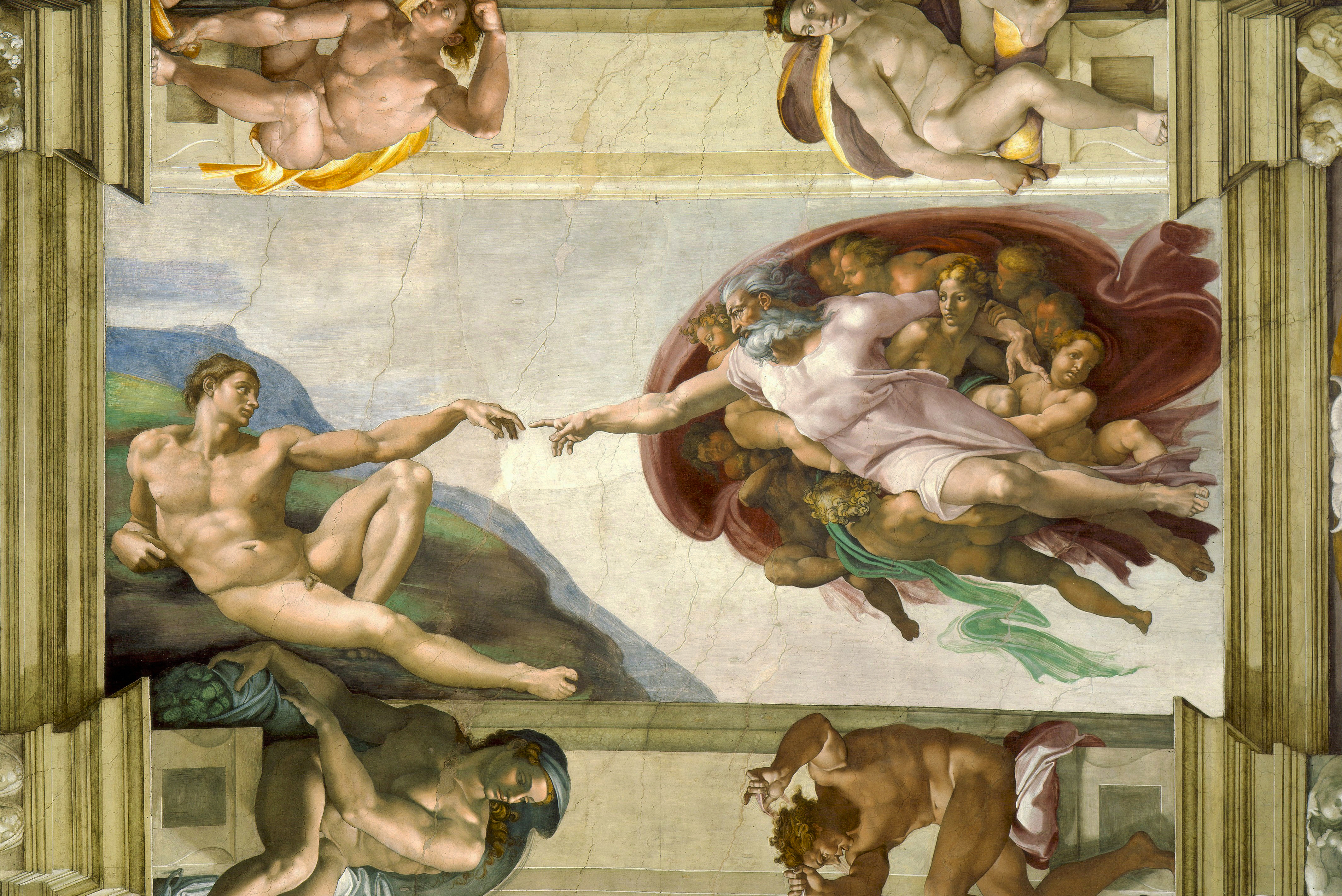
The Concept Of Sin: A Primer

The Concept Of Sin: A Primer

File:Creación de Adán.jpg

I recently read an article that touched on the issue of "sin", and decided to look up the word based on my teacher, Master David M. Berry's, teachings.

Master Berry teaches, quoting from the Bible, that "whatever may be known about God is in Man. (Romans 1:19)" Regarding sin, he teaches that sin is ignorance. So when I came across this issue in my reading, I decided to end my ignorance regarding this concept.

First, we must consider the question: What is ignorance? Simply put, ignorance is being without knowledge. It means that the person who is ignorant on a topic or issue, doesn't know all there is to know about it. That would probably cover about 99.99 per cent of humanity, if not more. To anyone's knowledge, nobody on earth knows everything about everything. So EVERYBODY is ignorant.

Now let's go to the concept of "sin". The "traditional" definition is an act or omission that is against God, or words to that effect. Encyclopedia Brittanica defines "sin" as
"moral evil as considered from a religious standpoint. Sin is regarded in Judaism and Christianity as the deliberate and purposeful violation of the will of God." The American Heritage dictionary states that the word is from the "Middle English sinne, from Old English synn", meaning: "1. To violate a religious or moral law. 2. To commit an offense or violation."

But something that has apparently been forgotten came to mind while reading that article that mentioned sin. The English language, including middle and old English, is largely based on the ancient Latin. This stands to reason when we consider that the ancient Roman Empire had a great sway over Brittain, even to the point of having a hand in the legend of King Arthur, who was listed in ancient Roman texts as "Arturus, Dux Bellorum" (Arthur, Duke of War). Then I recalled that Spanish and Italian are even more closely rooted in Latin. The Spanish word, "sin", means "without"; and the Italian is "senza". Even in French, "sanz" is very close to the Latin root word, "sine" (pronounced, in Classical Latin: si-nay), which means "without".

To further this concept, the Latin words "absque", "foras" and "vacuus" are synonymous with "sine"; they ALL mean "without". To go further yet, "vacuus" also means "empty, devoid of, free from, useless". In other words, "without" something. But without WHAT, exactly?

We're dealing with the concept of "sin", which has been said by traditionalists to mean "against God". But what is God? God is the ultimate Truth! So to be in sin is to be without God, without Truth. It has nothing to do with any transgression, it is, as Master Berry states, ignorance. It's being devoid of KNOWLEDGE. Since Knowledge is Power, it means that "sin" is "powerlessness".

To correct this state of condition, Jesus the Christ said, "Know the Truth, and the Truth will set you free."

Yet Truth is this: We CANNOT be without God, for God is in and of everything that exists. "Behold, I am with you, always."

But we are, in Truth, without knowledge. What knowledge, you may ask? The knowledge of our God-hood, our divinity. "Does not your Law say, I said, You are Gods?" And even if we accept this Truth as our own, what good does it do us, if we don't know how to BE Gods? None whatsoever. Therefore, we must learn how to be that which we have been given to be.

Monday, February 27, 2012

Evolutionary Creation

The Evolution Of Man


In the Beginning God created Man.
Or did Man create God?
Only He and We understand.

Through the first nine months evolving
In the womb of Woman-kind,
We go through these symbolic changes.
But one day soon our race will find
That once again we need the aid
Of our Creator, the One We made,
Who helps us learn and helps us grow,
To help us change just one more time,
Into the race we truly need,
To right our wrongs, to end our greed,
To find Hope, gain Peace,
And use our Mind.

Copyright © Donald Charles Rice

Monday, February 20, 2012

The "Nappy Hair" Affair

I first read this article in the St. Petersburg Florida Times, and posted on my first website in Geocities in 1999.  It was written by a black columnist whose name I don't remember.  I thought I'd post it here in light of the current controversy surrounding Nicki Minaj.


The "Nappy Hair" Affair


A third grade teacher in Brooklyn, New York wanted to
help her
students of African and Latino descent build
some self-esteem. So she introduced them to
"Nappy
Hair," a book written by Carolivia Herron, who is an
American of African descent, as well as an assistant
English professor at
California State University.
Professor Herron wrote the book in celebration of the
unbreakable spirit of a little girl and her untameable
hair. The book describes the young girl as having
"the kinkiest, the nappiest, the fuzziest, the most
screwed up, squeezed up, knotted up, tangled up, twisted
up, nappiest hair..."
It has been reported that the tale is, in fact, based
on stories created by Professor Herron's uncle, about
her and her own nappy hair, of which she is uncommonly
proud. It has also been reported that few of those
parents had any children in Ms. Sherman's class, and
that none of them had read the book at all.
But the teacher, Ruth Sherman, was totally unprepared
for the consequences of her action. She was taken out
of her classroom and transferred to an office job, and
some of the parents of students have threatened her life.
Why did this happen, one might wonder. Was it because
of the teacher's
skin shading? Or that she had the utter
audacity to want to teach self-esteem to children not of
her so-called "race?" The answer is, both and more.
It seems that Ms. Sherman, in choosing that book, walked
into a firestorm of racial self-hatred in the United States.
Since slave days, the standard of beauty and acceptance that
has been brainwashed into our heads is having
light skin
and straight hair. Even now, there are many older Americans
of direct African descent who remember their parents forcing
them to get their hair burned and straightened, in the name
of "beauty" and "acceptance."
Chicago Tribune columnist Clarence Page wrote, "The
'Black is Besutiful' movement of the late 1960's tried to
liberate black Americans from the tyranny of the hot comb,
a lsting symbol of our oppressive fealty to European
standards of beauty. But the durability of hot combs and
other black hair straightening products shows that black
subservience to European standards of beauty remains
largely unbroken, especially for James Brown and the
Rev. Al Sharpton."
Even though the protesting parents completely missed the
point, the children in Ms. Shermans' class loved the book,
according to school officials. And interestingly, Newsweek
reported, "Even after all the commotion, some parents
admitted they still hadn't read the book."

Wednesday, February 8, 2012

On The influence Of Music

One of the blogs I read and post on has a piece on how music affects children.  The point is that children tend to internalize what they hear and listen to.  I got to that blog post afte it had been up a while, and found quite a discussion going on.  So after reading several comments,  I decided to put in my two cents worth.  Re-reading it later, I realized I had written and dang blog post.  So I decided to repost it here, on my own blog.

The original blog discussion is here:

Could the Message Be in the Music? What White Kids Listen to Versus What Black Kids Do.

Kudos (Props) to the author of that blog, my online friend, Christelyn Karazin!

Enjoy!

~~~~~~~~~~~~~~~~~~~~~~~~~~~~~~

Okay, I just got to this post. I've only read a few of the comments, and from that it seems that there's a disparity of perception of the internalization of music. don't know if this will help, but I can relate my own experience. Maybe i'm different than most people, but I've observed that if a song speaks to me, no matter if the artist white, black, hispanic, or purple with pink polka dots, I'm most likely going to internalize it.

I've commented on at least one other blog here that when I was growing up, the only "black" singers allowed in my home were Nat "King" Cole and Charlie Pride. Out of their songs, the only ones that really spoke to me were "Unforgettable" (Cole) and "Kiss An Angel Good Morning" (Pride). Other songs that spoke to me were the Beatles' "Can't Buy Me Love" and Simon and Garfunkel's "The Boxer" and "The Sound Of Silence".

Later, as I grew up, the ones that spoke to me became more the "social message" songs and less the "romantic" and "love" songs. Ones like John Lennon's "Imagine" and The Beatles' "Eleanor Rigby". And later yet, after I got out from under my family, I was exposed to other music that spoke to me, which I also internalized: "Black and White" by Three Dog Night. "Brother Louie" by The Stories. All "social message" songs.

Then I was introduced to "soul" music. Barry White, Gladys Knight, Aretha Franklin, Marvin Gaye, and so on. And that music REALLY spoke to me. I understood almost immediately why it was called SOUL music. And for a while, I silently cursed my family for keeping this beautiful experience from me. And once again I literally fell in love with "love" music. "I Stand Accused" by Isaac Hayes. "Midnight Train to Georgia" by Gladys Knight and the Pips.

But this wasn't the only music I internalized; I syill loved the "social message" songs like "One Tin Soldier" from the movie "Billy Jack". And the juxtaposition of the different types of music I liked and internalized made me realize that it's not the KIND of music, it's what the music says that speaks to me.

But when I first heard "rap", it was the "gangsta" rap. was immediately turned off. I hated it; it glorified destruction and mayhem. It definitely wasn't for me. And when I was later with Carolyn, this was one of the very few things we argued about. Tired of the arguing, I agreed to listen to the words of a couple of Tupac's songs. I don't remember which ones, but when I really listened to them, I realized that he had a message too, one of uplift and hope. But I still disliked it because of the language; as I saw it, there was no need to swear in music. I told Carolyn this, and she agreed in principle, having been raised in the R&B industry. But she also told me that Tupac was able to reach some of the people who were wrapped up in that so-called "culture" with his songs.

To this day, I don't know if it was true. But I do know that there are always possibilities. And I recalled one of the few rap songs I DID like before I was with Carolyn. It was a song by Queen Lateefa: "U.N.I.T.Y." And what stuck with me from that is the main line, the message for the women, especially the AA women: "You gotta let 'em know, you ain't a b*tch or a hoe."

Yup. That's my story ,and I'm sticking with it.

Namaste',
Don